
P4I & IRES Webinar Recap:Climate Change and Political Exclusion
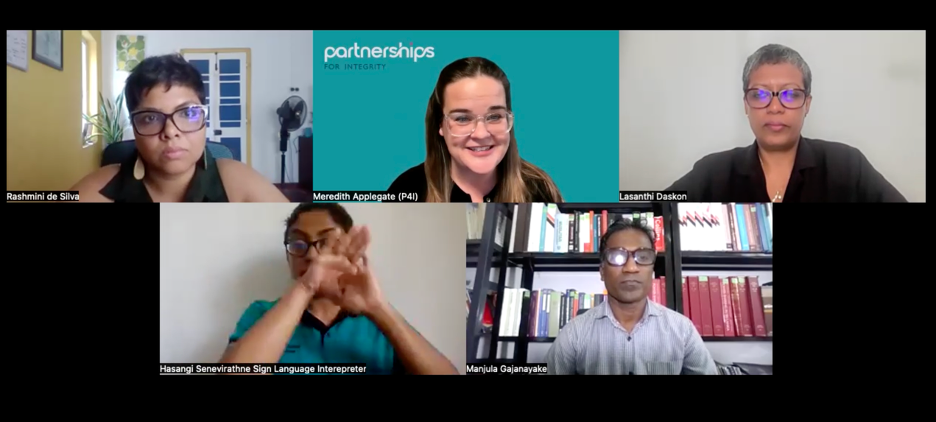
Speakers and moderators at the P4I and IRES event.
On January 21, Partnerships for Integrity (P4I) and the Institute for Democratic Reforms and Electoral Studies (IRES) hosted a webinar exploring how climate change and political exclusion are mutually reinforcing in Sri Lanka, and why inclusive governance is essential to climate resilience. The discussion was moderated by Meredith Applegate (P4I) and featured panelists Rashmini de Silva (Climate Change and Gender Expert), Manjula Gajanayake (Executive Director, IRES), and Lasanthi Daskon (Strategic Advisor, P4I).
Read our discussion paper on this topic here.
Key themes and takeaways
Speakers emphasized that climate impacts in Sri Lanka are not “neutral,” but instead unfold along existing social, economic, and political inequalities—with women, minority communities, persons with disabilities, and other excluded groups often experiencing the greatest harm while remaining least represented in decision-making. The panel drew from the P4I–IRES paper of the same title, which argues that exclusionary governance directly weakens the effectiveness of preparedness, response, and recovery.
A major focus of the webinar was how recent disasters have exposed governance gaps, including failures in:
Language accessibility, especially inadequate Tamil-language information dissemination during crises;
Disability inclusion, including limited accessible formats such as sign language and insufficient consideration of disability-related risks;
Transparent and representative coordination, where national-level decision-making structures have often excluded the perspectives of communities most affected by climate shocks.
Political inclusion as climate resilience
The panel underlined a central conclusion of the paper: political inclusion, especially women’s leadership, is not a “side issue,” but a core pillar of resilience. While Sri Lanka has introduced mechanisms like the 25% women’s quota in local authorities, speakers noted that increased numerical representation has not consistently translated into meaningful participation, power, protection from abuse, or leadership influence, particularly within crisis governance.
Speakers reinforced the need to shift from reactive disaster response to long-term inclusive governance, including:
Strengthening women’s leadership and capacity-building at national and local levels;
Ensuring accessible communication and inclusive planning “by default,” including disaggregated data;
Investing in well-resourced local authorities as frontline resilience institutions;
Transforming political culture to recognize marginalized groups as leaders and decision-makers, not merely beneficiaries.
Overall, the webinar made the case that Sri Lanka cannot build effective climate resilience without directly confronting the structural cost of political exclusion, and that inclusive governance is both a democratic imperative and a practical requirement for better climate outcomes.
